Micro Minesweeper
Micro Minesweeper: minesweeper with no multiplication, no division, and nothing wider than a byte.
In this post we’ll look at how the board addressing and the scoring stay inside that constraint, on boards up to 16x16.
Micro Minesweeper
No Multiply, No Divide
Most 8-bit CPUs have no multiply or divide instruction. Both are subroutines rather than opcodes, and are incredibly expensive. This project uses shifts, masks and repeated addition instead.
Two Facts
Everything after this follows from two facts:
-
8-bit math is modulo 256. We’re exploiting wrapping: go past 255 and land back at 0, perfect for this situation.
-
256 is 16 squared. A 16x16 board fills a byte index exactly, and the two coordinates are the two nibbles — row on top, column underneath.
Between them, every multiply, divide and modulo in the program turns into a shift or a mask:
| What we want | What we write |
|---|---|
y * 16 |
y << 4 |
i / 16 |
i >> 4 |
i % 16 |
i & 0x0f |
rand() % 256 |
rand() & 0xff |
The Board
The board is one 256-byte array, and a coordinate becomes an index with a shift and an or:
i = (y << SHIFT) | x;
Coming back out is a shift and a mask. Mine placement gets the same treatment — rand() & 0xff lands on a cell without a modulo.
That exact fit is also the limit. Sixteen columns is as wide as a byte index goes.
The Border, and Where It Runs Out
A cell’s value says what it is: 0 to 8 for the adjacent mine count, 9 for a mine, and higher numbers for cells already uncovered or flagged. The ordering is deliberate — anything dealt with sorts above anything still in play, so one >= test is enough to make a cell inert.
Cells off the edge of the active board hold 31, past the top of that range. Every operation skips them, so there’s no bounds checking anywhere. And on a board narrower than sixteen, that dead region doubles as a border and does the edge work for us.
At a full sixteen there isn’t one. Index 15 is (f, 0). Index 16 is (0, 1). Next door in memory, opposite ends of the board.
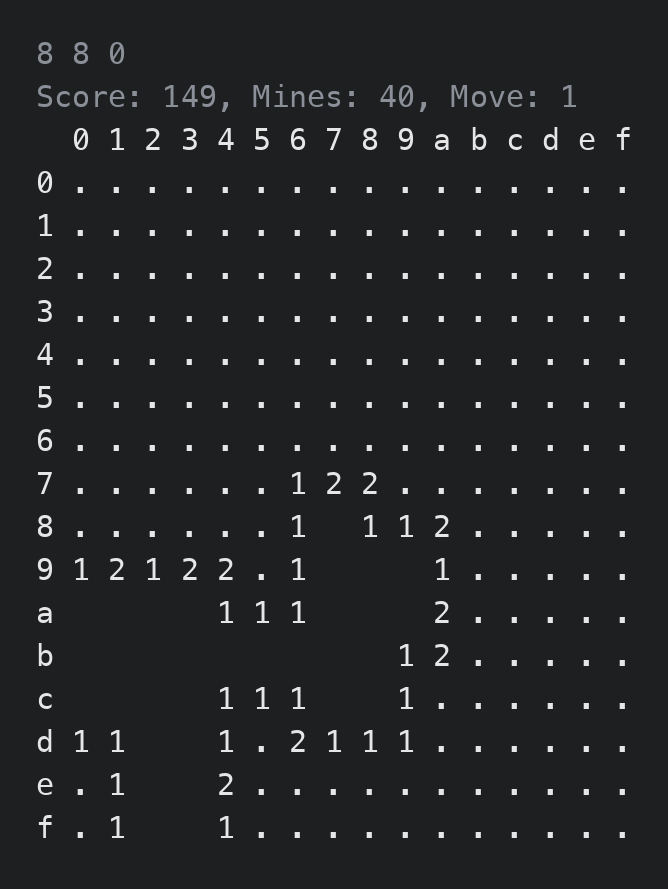 One probe at
 8 8. The fill runs out to column 0 and down to row f — both edges — and stops where it should.
Here’s where the first fact earns its keep. Running off the end of a row doesn’t run off the array; it lands us in the row below. So the row number is the test, and by the second fact the row is the top nibble.
This is the loop that walks three cells of a row, applying fn to each one that’s actually on it:
for (k = 0; k < 3; k++, j++) {
	if ((j & ROW) == row) {
		board[j] = fn(j, board[j]);
	}
}
ROW is 0xf0. One mask, one compare, and neither end of the run is a special case.
Rows that fall off the top or the bottom of the board are tested directly:
int box(uint8 i, uint8 (*fn)(uint8, uint8))
{
	uint8 y = i >> SHIFT;

	if (y) {
		box_row(i - STRIDE - 1, (i - STRIDE) & ROW, fn);
	}

	box_row(i - 1, i & ROW, fn);

	if (y < MASK) {
		box_row(i + STRIDE - 1, (i + STRIDE) & ROW, fn);
	}

	return 0;
}
That’s where row comes from: each call is handed the row it’s meant to stay on — (i - STRIDE) & ROW above, i & ROW level, (i + STRIDE) & ROW below — and box_row holds it to that.
Counting Safe Cells
score is the number of safe cells still covered — cells minus mines to start, which fits a byte on any board with a mine on it. Uncover a cell and it drops. Flag one and it doesn’t. Zero means we’ve won.
Seeding it doesn’t need a wider type either. The layout pass paints the board and counts the playable cells as it goes:
for (y = 0, i = 0; y <= MASK; y++) {
	for (x = 0; x <= MASK; x++, i++) {
		if (x < width && y < height) {
			board[i] = 0;
			score++;
		} else {
			board[i] = INVALID;
		}
	}
}
On a full board that runs to 256 and rolls straight over to zero. Then the mines come off the top:
score -= m;
First fact again, and this is the bit I like: the subtraction lands on the right answer even though the count didn’t. On intermediate we want 256 - 40, which is 216. What we compute is 0 - 40, which in a byte is also 216. The total doesn’t fit, the difference does, and only the difference is ever asked for.
Reflections
516 bytes of game state: the board, a 256-byte stack for the flood fill, three bytes of geometry, and the score. Nothing wider than a byte anywhere, and no multiply or divide in the source.
The code is on GitHub as microminesweeper.
Next Steps
The one thing we haven’t got is the traditional expert board. That’s 30x16, and thirty columns won’t fit a byte index however we arrange them, so expert is squared off at 16x16 with the same 99 mines — a nastier game than the original.
Going wider means a 16-bit index and a rethink of everything above. We’ll cross that bridge if we come to it.